
5 Traditional Indian Board Games You Can Play on Your Phone
India gave the world chess, Ludo and Snakes and Ladders. Here are 5 traditional Indian board games that now have free versions for your phone.
 Saathi Games Team
In this article
- 1. Anthi Chanda (Chowka Bhara / Ashta Chamma)
- 2. Pachisi (Chaupar)
- 3. Pallanguzhi (Mancala)
- 4. Moksha Patam (Snakes and Ladders)
- 5. Chaturanga (the Ancestor of Chess)
- Why Traditional Indian Board Games Still Matter
- How to Pick a Good App for Traditional Indian Board Games
- Which Game Should You Start With?
- Frequently Asked Questions
- Start With Anthi Chanda
Traditional Indian board games have travelled much further than most people know. Chess began as Chaturanga. Ludo comes from Pachisi. Snakes and Ladders was once Moksha Patam, a game about karma and fate.
Many of these games are still played in homes across India, on cloth boards, with cowrie shells and tamarind seeds. Now several of them have free mobile versions, so you can play them anywhere, from Lucknow to London.
Here are five traditional Indian board games you can play on an Android phone, plus a few tips for picking a good app.
1. Anthi Chanda (Chowka Bhara / Ashta Chamma)
Origin: India. The Google Play listing calls it one of India's oldest and most loved strategy board games.
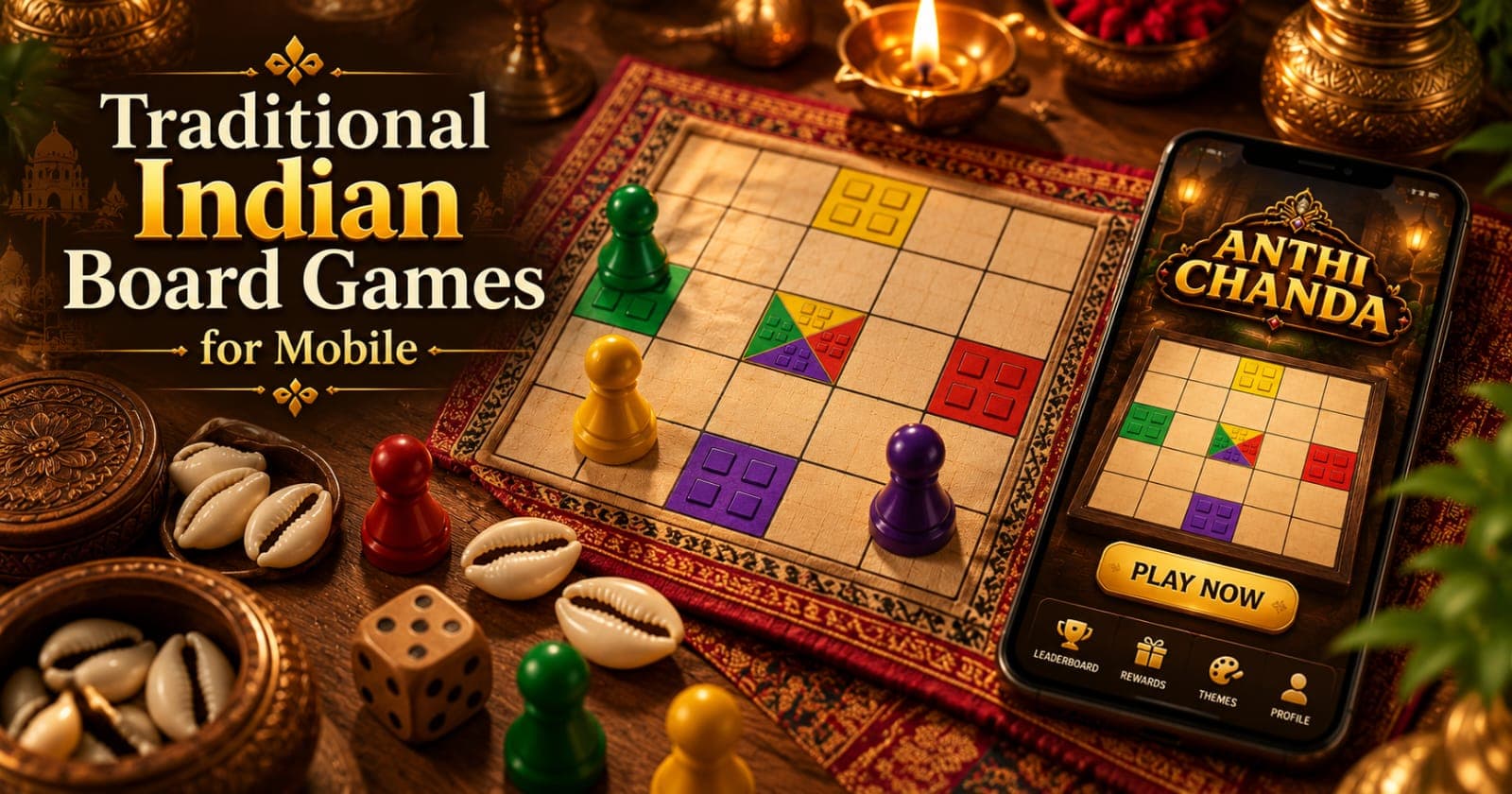
What it is: A race game on a 5×5 grid. You throw four cowrie shells instead of a die and count how many land face up. It is known as Chowka Bhara in Karnataka and Ashta Chamma in Andhra Pradesh and Telangana. Other names include Chowka Bara, Ashta Kashte, Daayam and Thaayam.
Why it is special: All four shells face up is a Chanda, worth 4 steps and a bonus throw. All four face down is the Anthi, worth 8 steps and another throw. Every pawn starts on the board from the first throw, so nobody waits for a special number to enter. Two of your pawns on one square form a protected pair that no rival can cut or land on. That makes blocking a real part of the game.
Mobile version: Anthi Chanda by Saathi Games is free on Google Play and rated 3+. You can play the computer at three levels, pass one phone between 2, 3 or 4 players, or team up in a 2v2 Team Battle. You can also create a private room and share the code with friends. Vs Computer and Pass and Play work without the internet. The app contains ads.
Download Anthi Chanda on Google Play
2. Pachisi (Chaupar)
Origin: Ancient India.
What it is: The ancestor of Ludo. It is played on a cross-shaped board with cowrie shells or special dice. Four players race their pieces from start to finish and capture rivals along the way. The Mughal emperor Akbar is said to have played a life-sized version at his court in Fatehpur Sikri, with people as the pieces.
Why it is special: Pachisi has more strategy than Ludo. Two players can team up as partners. Two pieces on one square form a barrier. And the throws vary more, which makes each choice count.
Mobile versions: Several Pachisi apps exist on Google Play, but many take liberties with the rules. Look for one that uses traditional cowrie-based moves rather than a standard die.
3. Pallanguzhi (Mancala)
Origin: Tamil Nadu. It spread across South India and Southeast Asia.
What it is: A two-player game of counting and capturing. The board has two rows of seven pits, and each pit starts with a set number of seeds. You pick up the seeds from one pit and drop them one by one into the pits that follow. Captures happen when your last seed lands in certain spots.
Why it is special: Pallanguzhi is pure strategy. Both players can see the whole board at all times, and there is no luck at all. The game rewards counting ahead and reading your rival's next move.
Mobile versions: Search for "Pallanguzhi" or "Mancala" on Google Play. Several free versions exist, and the quality varies.
4. Moksha Patam (Snakes and Ladders)
Origin: Ancient India, where it began as a way to teach right and wrong.
What it is: The game the West knows as Snakes and Ladders. The first version used the board to teach karma. Ladders stood for virtues such as faith, generosity and knowledge, which lift you up. Snakes stood for vices such as lust, anger and greed, which pull you down. The goal was to reach moksha, or liberation, at the top.
Why it is special: The old game was not really about winning. It taught that life has ups and downs shaped by what you do. The British version dropped those lessons and turned it into a children's game of pure luck.
Mobile versions: There are countless Snakes and Ladders apps on Google Play. Most use the simple Western version. A few bring back the old Sanskrit square names and the moral meaning.
5. Chaturanga (the Ancestor of Chess)
Origin: India, around the 6th century.
What it is: The direct ancestor of modern chess. It was played on an 8×8 board called the ashtapada. Its pieces later became the king, queen, bishop, knight, rook and pawn. Some moves were different. The elephant, which became the bishop, moved in another way, and there was no queen as we know it.
Why it is special: Chaturanga may be India's most famous gift to the world of games. From India it spread to Persia, where it became Shatranj. Then it moved to the Arab world and on to Europe, where it grew into modern chess.
Mobile versions: Standard chess apps on Google Play are its modern form. For the old Chaturanga rules, you will need a niche app. Search for "Chaturanga" or "ancient chess".
Why Traditional Indian Board Games Still Matter
These five games hold centuries of Indian game design. Anthi Chanda and Pachisi show how luck and planning can mix in a race game. Pallanguzhi is a lesson in pure strategy. Moksha Patam packed a whole way of life into a board. And Chaturanga grew into chess, which people now play all over the world.
They are also games for people, not just for screens. In Hindi, a saathi is a companion: the person across the board from you. Most traditional Indian board games are at their best with a friend or a family member sitting right there. A phone simply means you can still play when that board and those shells are far away.
How to Pick a Good App for Traditional Indian Board Games
Not every app treats these games with care. Before you install one, run through this short list.
- Check the rules. Read the store listing and see if the rules match the game you know. Some apps change a lot.
- Look for offline play. If you play on trains or flights, check which modes work without the internet.
- Check for ads and in-app purchases. Google Play shows "Contains ads" and "In-app purchases" near the install button. Know what you are signing up for.
- Check the age rating. If kids will play, make sure the rating suits them.
- Look for pass and play. Many of these games shine with family, so a mode for one shared phone is a big plus.
- Read recent reviews. They tell you how the app runs today, not just at launch.
- Watch the permissions. A board game should not need your contacts or your messages.
Which Game Should You Start With?
If you are new to traditional Indian board games, match the game to the people you play with.
- For a family race game, try Anthi Chanda or Pachisi.
- For a quiet two-player battle of wits, try Pallanguzhi or Chaturanga.
- For young children, Snakes and Ladders is the easy pick.
Frequently Asked Questions
Which traditional Indian board games can I play on my phone?
All five on this list. Anthi Chanda has its own free app from us. Pachisi, Pallanguzhi and Snakes and Ladders have several versions on Google Play. For Chaturanga, you can play modern chess or look for a niche app with the old rules.
Is Ludo an Indian game?
Ludo is a British game from 1896, but it is a simpler form of Pachisi, the ancient Indian race game. So its roots are Indian.
Is Anthi Chanda the same as Ludo?
No. The two share a distant common ancestor, but they play very differently. Read our Anthi Chanda vs Ludo comparison for the details.
Are traditional Indian board games good for kids?
Many of them are. Snakes and Ladders is simple enough for small children. Pallanguzhi involves a lot of counting. The Anthi Chanda app is rated 3+ on Google Play.
Do these apps need the internet?
It depends on the app. In Anthi Chanda, Vs Computer and Pass and Play work offline. For other apps, check the store listing.
Start With Anthi Chanda
You no longer need a cloth board and a handful of shells to play traditional Indian board games. Start with Anthi Chanda. We are biased, since we built it in Lucknow, but it is the one on this list we know inside out.
New to the game? Our guide to the rules and strategy will get you playing in minutes. You can also browse all Saathi Games apps.