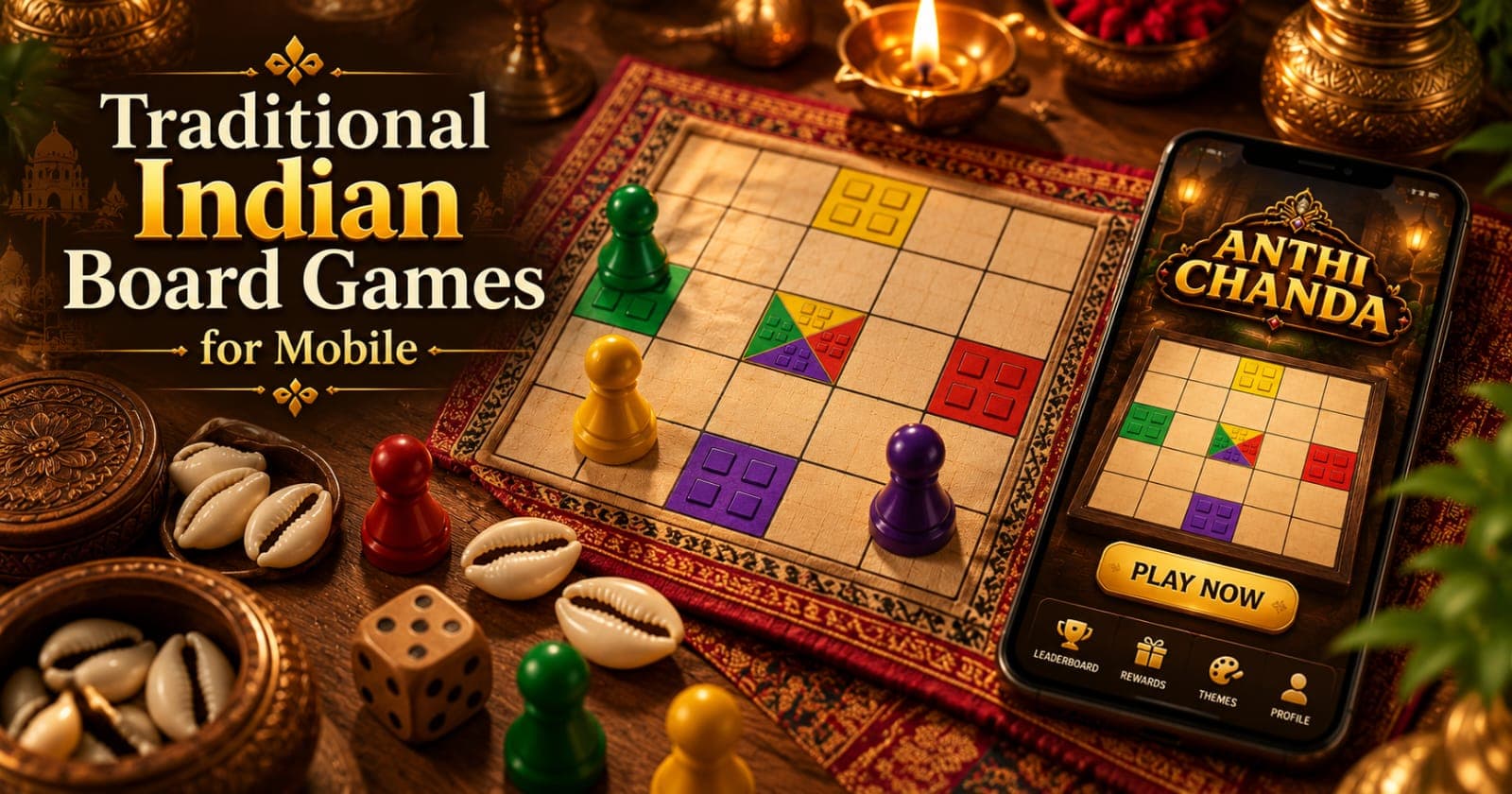
Anthi Chanda vs Ludo: India's Traditional Board Game Compared
Anthi Chanda vs Ludo: both trace back to Pachisi, but cowrie shells, no entry roll and protected pairs make them very different games. Here's how.
 Saathi Games Team
In this article
Anthi Chanda vs Ludo is a natural comparison if you grew up with one game and have just found the other. Both are race games. In both, you move pawns around a board and knock rivals back to the start. Yet they feel very different once you play.
Anthi Chanda is one of India's oldest strategy board games. It is called Chowka Bhara in Karnataka and Ashta Chamma in Andhra Pradesh and Telangana. Ludo is the race game much of the world grew up with. This guide covers where the two come from, how their rules differ, and which one suits you.
Where Both Games Come From
Any honest Anthi Chanda vs Ludo comparison starts with history. Both games trace back to Pachisi, the ancient Indian cross-and-circle race game. Pachisi is also the origin of Parcheesi. Anthi Chanda belongs to the same family, and it was traditionally played with tamarind seeds and cowrie shells.
Ludo came much later. It is an 1896 British simplification of Pachisi, and it uses a single die in place of shells.
So is Anthi Chanda simply the "original" Ludo? Not quite. The Google Play listing for the app puts it carefully: the two games "share a distant common ancestor but they are genuinely different games." Think of them as cousins. Anthi Chanda is not a Ludo reskin, and Ludo is not a copy of Anthi Chanda.
Anthi Chanda vs Ludo: The Rules Side by Side
Here is a quick comparison. The Ludo column describes the classic rules most people know. House rules vary.
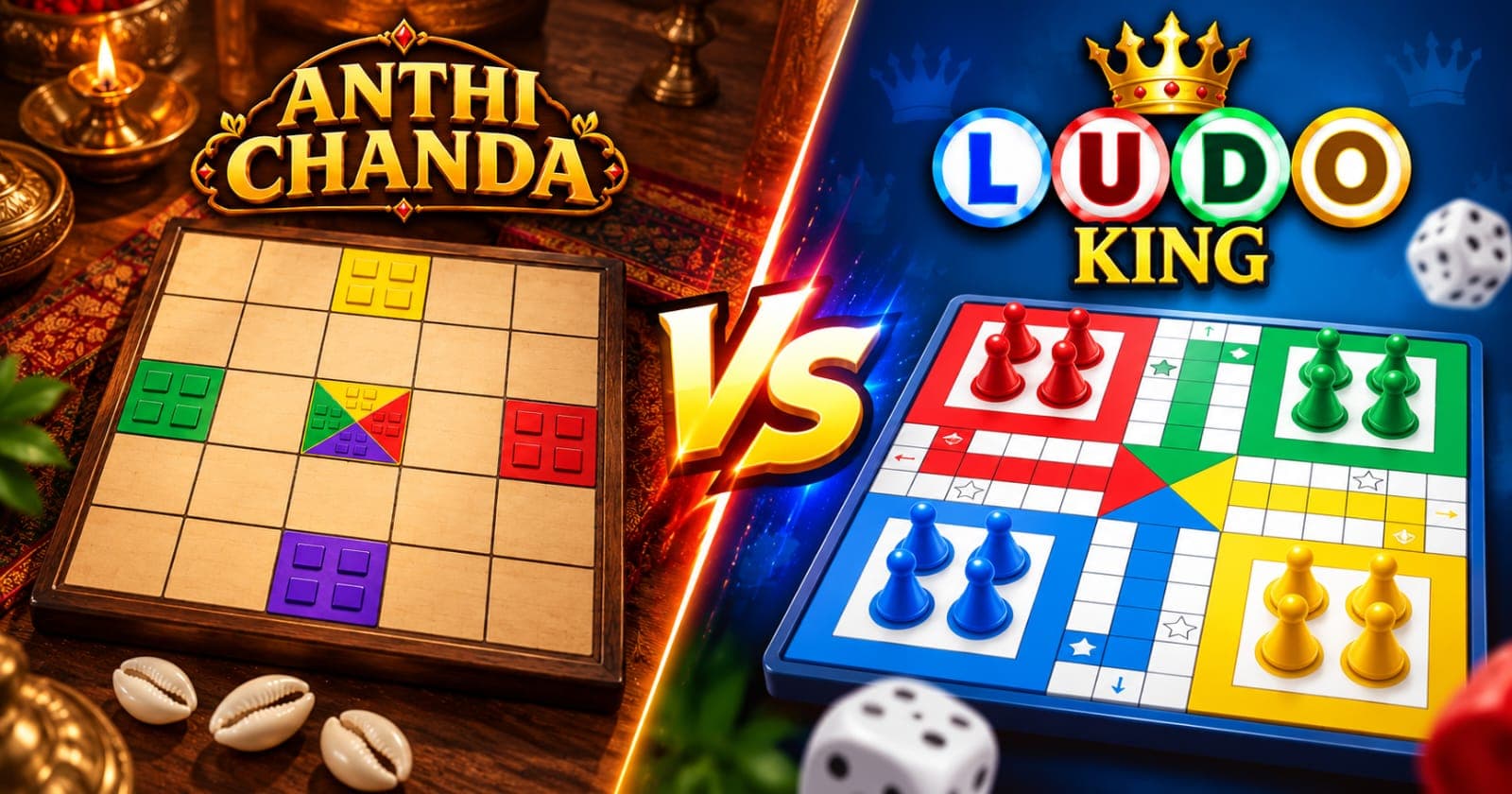
| Feature | Anthi Chanda | Ludo |
|---|---|---|
| Board | 5×5 grid | Cross-shaped board |
| Throw | Four cowrie shells | One six-sided die |
| Values | 1, 2, 3, 4 or 8 | 1 to 6 |
| Entering | All pawns start on the board | Roll a 6 to enter |
| Extra throws | Chanda, Anthi and every cut | Rolling a 6 |
| Protection | Pairs cannot be cut | Depends on house rules |
| Finish | Land exactly on the centre | Reach home |
The Biggest Differences
Cowrie Shells, Not a Die
The first thing you notice in any Anthi Chanda vs Ludo match-up is the throw. In Anthi Chanda, you throw four cowrie shells and count how many land face up. That number is your move. All four face up is a Chanda, worth 4 steps and a bonus throw. All four face down is the Anthi, worth 8 steps and yet another throw. The listing calls the Anthi "the powerful one".
This changes the feel of every turn. On a fair die, each number from 1 to 6 is equally likely. Shell throws bunch up in the middle instead. If each shell were a fair coin flip, a 2 would come up six times as often as a Chanda or an Anthi. Most turns are short steps, so a big throw feels like a real event.
No Rolling Just to Enter
In Ludo, you usually need a 6 to bring a pawn out. Some games start with a long wait for that 6. In Anthi Chanda, "every pawn starts on the board from the very first throw. No rolling just to enter." You are in the race from your first turn.
Protected Pairs
Put two of your own pawns on the same square in Anthi Chanda and they become a protected stack. No rival can cut it. You also cannot land on an enemy pair, so blocking becomes a real strategy. The listing says the pair rule "adds a layer of tactical depth Ludo simply does not have."
Cuts Pay Twice
In both games, landing on a rival's pawn sends it back. In Anthi Chanda, you cut by landing exactly on a lone pawn. The pawn goes all the way back to its starting square, and every cut earns you a bonus throw right away. So one move sets your rival back and gives you another throw.
Two Rings and an Exact Finish
Anthi Chanda pawns travel the outer ring first, then the trickier inner ring, and must land exactly on the centre square to finish. The outer ring has 16 squares and the inner ring just 8, so pawns meet often. Ludo has a longer shared track and a home column for each colour, which leaves more room to spread out.
Is Anthi Chanda More About Skill?
This is where the Anthi Chanda vs Ludo debate gets interesting. Both games mix luck and choice. Nobody controls how the shells or the die land. The skill is in what you do with each throw.
In our view, Anthi Chanda gives you more of those choices. You decide which pawn moves, when to form a pair, and when to go for a cut. Pairs mean you can block, not just run. Bonus throws from cuts reward sharp play. And with no entry roll, all four of your pawns are useful from the start.
Ludo has real decisions too, such as which pawn to move and when to take a risk. But a game of Ludo can often turn on who rolls the sixes. That is part of its charm.
You can see the difference when you play the computer. In the Anthi Chanda app, Hard bots "think a step ahead, weigh every throw probability." That tells you how much a single move can matter.
Anthi Chanda vs Ludo: Which Should You Play?
Play Ludo if you want a game that everyone at the table already knows. It is quick to set up and easy for young children. It is a good pick for a relaxed evening when nobody wants to think too hard.
Play Anthi Chanda if you want more tactics in a race game. Pick it if you enjoy blocking, cutting and planning ahead, or if you want to play the game your grandparents played. Its 2v2 Team Battle mode also makes it a strong choice for game night.
You do not have to choose, of course. If you grew up with Ludo or Parcheesi, in India or abroad, Anthi Chanda is a fun way to meet the other side of the family tree.
How to Play Anthi Chanda on Your Phone
The Anthi Chanda app is free on Google Play and rated 3+. It contains ads. It is Android-only for now, and iOS is on the roadmap. The app comes from Saathi Games, an independent studio in Lucknow. Made in India, free for the world.
Here are the ways to play:
- Vs Computer, with bots at Easy, Medium and Hard.
- Pass and Play, with 2, 3 or 4 players on one device.
- Team Battle 2v2, where you and a partner work to get all 8 of your pawns home first.
- Play with Friends, where you create a private room and share the code.
You do not need the internet for Vs Computer or Pass and Play. You can also dress your board in themes like Diwali Night and Mughal Garden.
New to the game? Our step-by-step guide to the rules and strategy walks you through every throw.
Frequently Asked Questions
Did Ludo come from India?
In a sense, yes. Ludo is an 1896 British simplification of Pachisi, the ancient Indian race game.
Is Anthi Chanda older than Ludo?
Its family is far older. Ludo dates from 1896. The Play listing calls Chowka Bhara "one of India's oldest and most beloved strategy board games."
I know Ludo. Is Anthi Chanda hard to learn?
Not really. The race and the cuts will feel familiar. The new parts are the cowrie throws, the protected pairs and the exact finish on the centre square. A game or two against the Easy bot is a good way to learn them.
Anthi Chanda vs Ludo: which is better for kids?
Ludo is simpler for very young children. The Anthi Chanda app is rated 3+, but its tactics will appeal most to older kids and adults. Pass and Play lets the whole family share one phone.
That is Anthi Chanda vs Ludo in short: same ancient roots, very different games. If you have only ever played Ludo, give its Indian cousin a few rounds.
Download: get Anthi Chanda: Chowka Bhara free on Google Play.